Here's an uncomfortable thing we've noticed in our coaching practice. The most positive founders tend to break first.
Not the cynics. Not the doubters. The ones who walk into every call convinced this quarter is the one.
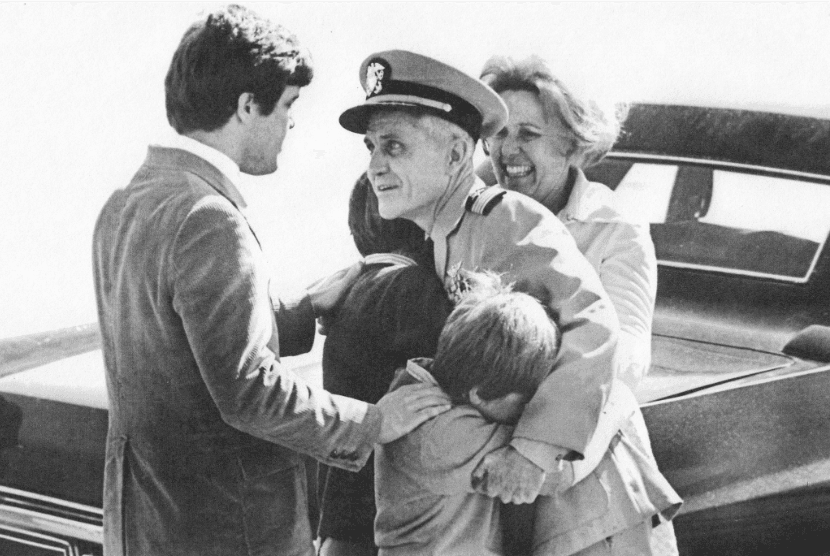
Admiral Jim Stockdale spent nearly eight years in a Vietnamese POW camp. Tortured more than twenty times. When Jim Collins later asked him who didn't make it out, Stockdale didn't hesitate:
"Oh, that's easy," he said. "The optimists. They kept saying, we'll be out by Christmas. Christmas came. Then Easter. And they died of a broken heart."
Optimism is not what you think it is
Read that again. The optimists died first.
The ones who kept tying hope to a short-term deadline and collapsed when the deadline came and nothing changed.
Sound familiar?
"If we just close this round." "If we just land this customer." "If we just survive Q4." Hope, crash, hope, crash. Until the energy runs out.
81% of founders rate their own odds of success at 70% or higher. That's not confidence. That's Christmas-is-coming optimism dressed up in a pitch deck.
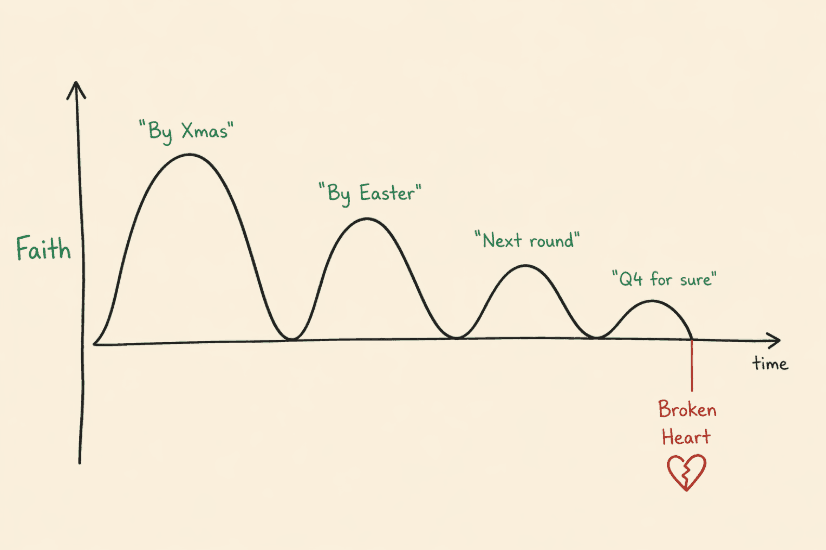
Here's what we see in coaching. Some founders ride this cycle for years. Sometimes the hope pays off. The round lands, the customer signs, the crisis passes. But for most, there comes a stretch where nothing lands. And when the floor keeps dropping out, something breaks.
The real question isn't whether you're optimistic. It's whether your optimism can survive contact with reality.
The paradox
Stockdale survived because he held two things at once.
Unshakeable faith that he would prevail. The image of his wife and children in his arms again. No matter how many years it took.
And the discipline to face the brutal facts of his reality, exactly as they were.
That's not optimism. Optimism says "it'll get better by Q4." Faith says "I'll get through this. It might take years."
Two ways founders fall
We see two failure modes in coaching, and they're mirror images of each other.
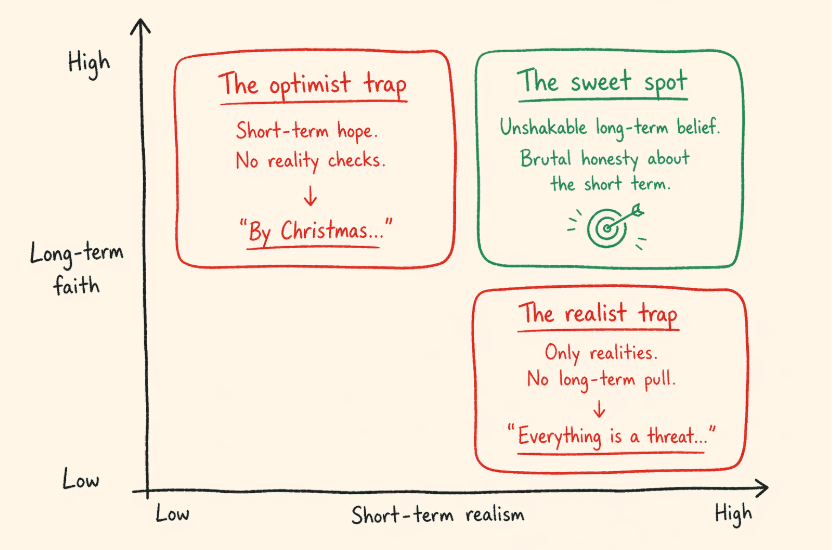
The optimist trap: long-term faith, no short-term honesty. Every setback gets reframed. Every brutal number gets a redemption arc. Until the floor drops out.
The realist trap: razor-sharp on this week, no long-term pull. Every missed target feels existential because there's no deeper thing the founder is anchored to.
I worked with a founder recently who was 18 months into a hope cycle. Every quarter had a savior: a round, a key hire, a pivot, a big deal. Every quarter, something landed just close enough to keep going. By the time she reached out, she was running on fumes and couldn't tell you what she was actually building toward. Not because she'd lost the vision. Because she'd stopped hearing it over the noise of the next deadline.
How you find your long-term faith
Here's the part most founders get wrong. Long-term faith isn't built. You don't construct it at an offsite or write it into a strategy doc. You find it.
Most founders have the answer. They've just stopped hearing it because the next fundraise, the next launch, the next hire is louder than the signal.
Long-term belief, short-term realities
Jim Collins saw the same in great companies. Not just optimists. Not just pessimists. Both at once, in the right order. Great founders see and accept short-term realities, sourcing energy from a strong long-term belief.
One thing to try this week
Grab a notebook. Twenty minutes. Answer honestly.
- If the next round, customer, or quarter changed nothing — what would you still keep working on?
- What do you daydream about when no one's asking?
- What brutal truth are you not saying out loud right now?
Two for your faith. One for your facts.
Stockdale didn't survive because he was positive. He survived because he could hold two impossible things at once. Faith in where he was going. Honesty about where he was.
Building a company is not a POW camp. But we can learn from the discipline needed to survive.
Want to dig deeper?
Every founder has a blind spot. Our 2-minute audit surfaces yours and gives you one exercise to start working on it.
Start Your Audit